

Choosing a software development partner is a business decision that affects your budget, operations, customer experience and future growth. The right partner helps you turn business requirements into reliable software. The wrong one can leave you with missed deadlines, unexpected costs, security concerns and a product that is difficult to maintain.
If your business is planning a new application, modernising an existing system or investing in AI, you need more than a team that can write code. You need a partner who understands your objectives, communicates clearly and can support the software throughout its lifecycle.
This guide explains how to evaluate providers, compare proposals, identify risks and select a development partner that fits your business needs.
The best partner is not necessarily the cheapest or the one with the largest portfolio. It is the provider that demonstrates how its approach will solve your business problem, manage risks and deliver measurable results.
Why Choosing the Right Software Development Partner Matters
Software influences how businesses manage customers, process transactions, share information and make decisions. A poorly planned system can create operational bottlenecks instead of solving them.
Working with an experienced Software Development Company can help your business develop applications around its specific workflows rather than forcing employees to adapt to unsuitable tools.
A suitable partner can also help you:
- Improve operational efficiency: Automate repetitive tasks and reduce manual data entry.
- Integrate business systems: Connect existing applications, databases and third-party services.
- Scale with demand: Build an architecture that supports changing workloads and new features.
- Strengthen security: Introduce appropriate access controls, testing and data protection measures.
- Reduce delivery risks: Establish clear requirements, milestones and quality checks before problems become expensive.
However, these benefits depend on planning and execution. Hiring a provider does not automatically guarantee a successful product. Your business must remain involved in decisions, feedback and approvals throughout development.
7 Criteria for Evaluating a Software Development Partner

When comparing software development companies in Dubai and other providers serving UAE businesses, evaluate their delivery capabilities rather than relying on sales presentations alone.
1. Relevant Technical Expertise and Industry Experience
Start by checking whether the provider has experience with projects similar to yours. Relevant experience might include enterprise applications, ecommerce platforms, healthcare software, retail systems, SaaS products or AI-powered applications.
Ask prospective partners to explain the business problem, technical challenges, implementation approach and measurable outcomes of previous projects.
A strong portfolio should demonstrate how a solution worked, not simply show attractive interfaces.
Questions to ask:
- Have you delivered a project with similar requirements and complexity?
- Which technical challenges did your team resolve?
- Can you explain the architecture and important implementation decisions?
- What support was provided after launch?
If a provider cannot explain its work beyond general descriptions, request a more detailed technical discussion.
2. Understanding of Your Business Requirements
Technical skills matter, but the provider must also understand why you need the software.
For example, a retailer may want to reduce inventory errors, while a healthcare organisation may need better appointment management and secure information exchange. Both may require custom software, but their workflows, integrations and risks differ significantly.
A capable technology partner will ask about your users, existing systems, business objectives and operational challenges before recommending a solution.
Be cautious if a provider immediately proposes a large development project without discussing requirements, priorities or constraints.
3. A Transparent Development Process
A reliable partner should explain how your project will move from initial discovery to deployment and maintenance.
Look for a structured process covering:
- Discovery and requirements gathering
- Technical planning and architecture
- User interface and experience design
- Software development and integration
- Testing and quality assurance
- Deployment, monitoring and ongoing support
Ask how requirements will be documented, who approves milestones and how changes will affect the budget or delivery date.
Clear project management helps both parties understand responsibilities and identify problems early. Agile delivery can also help teams validate important features before investing heavily in the full product.
Clarify the Delivery Plan Before You Build
A software partner should be able to explain the process, milestones, risks and responsibilities before development begins.
4. Security, Privacy and Intellectual Property
Security should be considered from the beginning, particularly when software processes personal, financial, healthcare or commercially sensitive information.
Ask how the provider handles authentication, access permissions, encryption, vulnerability testing, backups and incident response. You should also establish where data will be stored and processed, who can access it, and whether cross-border transfers require additional review.
For UAE projects, assess applicable requirements under the UAE Personal Data Protection Law and any relevant sector-specific or free-zone rules. Requirements depend on the organisation, data and regulatory context, so obtain appropriate legal advice where necessary.
Your contract should also clearly define intellectual property ownership, source-code access, third-party licences, confidentiality and handover obligations.
Do not assume that paying for development automatically gives you unrestricted ownership of every component. Confirm the position in writing before work begins.
5. Communication and Team Availability
Poor communication can delay decisions even when a development team is technically capable.
Ask who will manage your project, who makes technical decisions and how frequently you will receive progress updates. Establish a shared process for reviewing work, reporting blockers and approving changes.
For distributed teams, confirm overlapping working hours, escalation procedures and availability during critical releases.
A dependable partner should make project status easy to understand. You should know what has been completed, what comes next, which decisions are pending and whether any risks could affect delivery.
6. Scalability and Post-Launch Support
Software needs often change after launch. User numbers grow, business processes evolve, integrations change and new security vulnerabilities emerge.
Evaluate whether the provider can support maintenance, performance monitoring, bug fixes, infrastructure changes and future feature development.
Ask who will maintain the codebase after launch, how support requests will be prioritised and whether service-level agreements apply.
The goal is to build software that your business can operate and improve over time, rather than becoming dependent on a provider for every minor change.
7. Commercial Transparency and Long-Term Value
Compare proposals based on scope, deliverables, assumptions and ongoing costs, not just the headline price.
A low initial quotation may exclude testing, integrations, deployment, documentation or maintenance. A higher quotation may include these activities, making direct price comparisons misleading.
Review the proposed team, delivery milestones, payment schedule, change-request process and exit arrangements.
The right partner should explain what is included, what is excluded and which factors could change the estimate.
How to Hire a Software Development Partner: A Step-by-Step Process

A structured selection process makes it easier to compare providers fairly and avoid decisions based on sales presentations.
Step 1: Define Your Business Goals
Identify the problem you want to solve and the result you expect.
Instead of saying, “We need a new business application,” define the intended outcome, such as reducing manual processing, improving order visibility or connecting disconnected systems.
Set measurable success criteria where possible. These might include processing time, error rates, user adoption or system availability.
Step 2: Document Your Requirements
Create a brief covering essential features, target users, integrations, security requirements, budget range and expected timeline.
Separate must-have features from enhancements that can be delivered later. This helps providers propose a realistic solution instead of estimating an unnecessarily large scope.
Step 3: Shortlist Suitable Providers
Search for a Software Development Company in Dubai or a distributed development partner that fits your requirements, delivery expectations and budget.
Review case studies, technical capabilities, service coverage and the experience of the team that would actually work on your project.
Avoid choosing a provider solely because it has a local office or a long list of technologies on its website. Verify the evidence behind its claims.
Step 4: Compare Proposals and Conduct Technical Discussions
Request proposals that explain the recommended solution, architecture, team composition, milestones, assumptions, risks and estimated costs.
Use the same requirements for every shortlisted provider so you can make a meaningful comparison.
During technical discussions, ask providers to explain trade-offs and how they would handle difficult requirements. If the project is complex, consider a paid discovery phase before committing to the full build.
Step 5: Finalise the Contract and Begin with Clear Milestones
Before development starts, agree on deliverables, payment terms, acceptance criteria, change requests, confidentiality, intellectual property and support arrangements.
Start with an agreed delivery plan and regular reviews. Approve completed work against defined criteria rather than relying on verbal assurances.
Turn Requirements Into a Practical Roadmap
If you are comparing development partners, a clear technical discussion can help you understand scope, risks and the right engagement model.
Which Software Development Engagement Model Should You Choose?
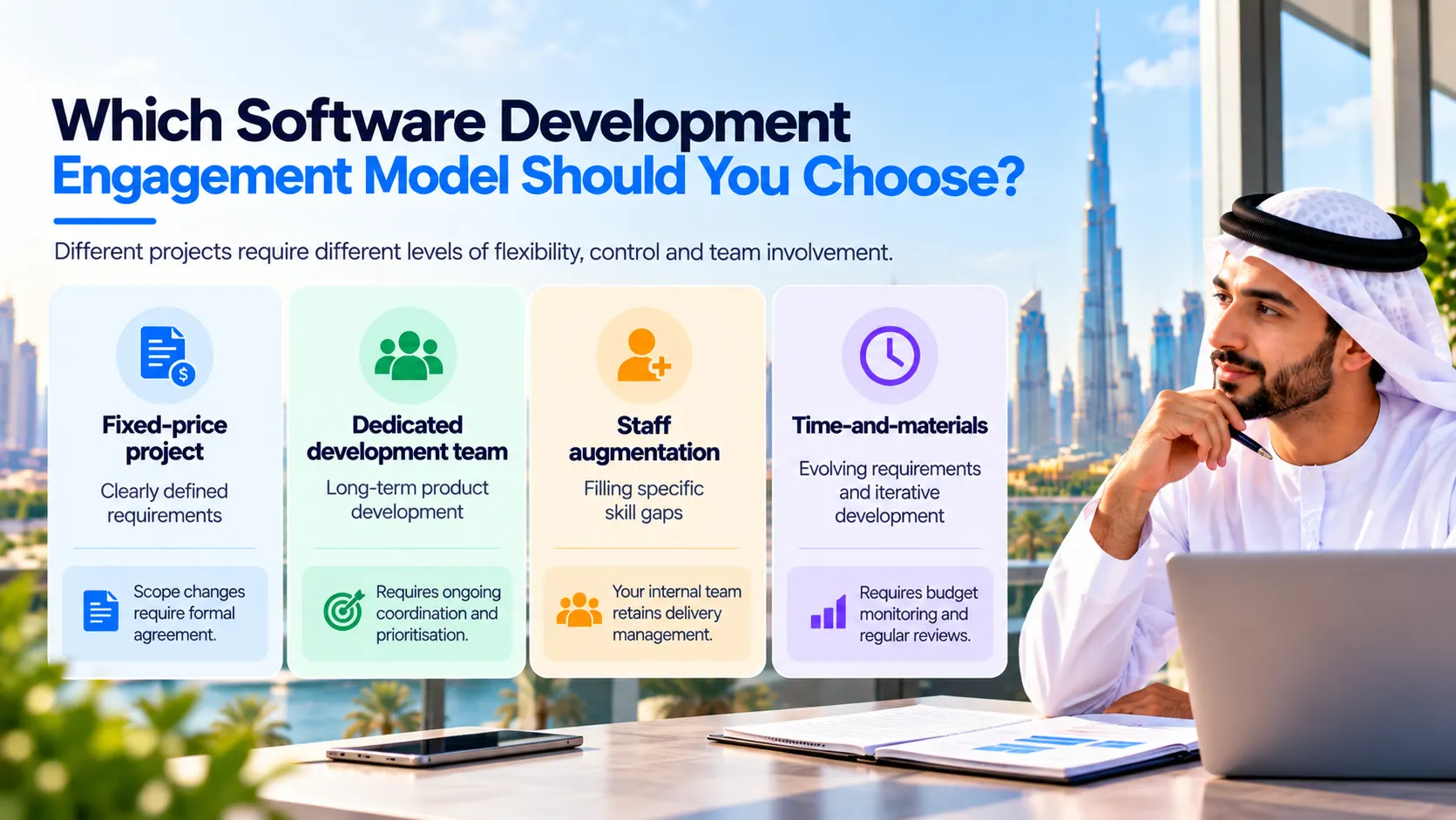
Different projects require different levels of flexibility, control and team involvement.
| Engagement model | Best suited for | Main consideration |
|---|---|---|
| Fixed-price project | Clearly defined requirements | Scope changes require formal agreement |
| Dedicated development team | Long-term product development | Requires ongoing coordination and prioritisation |
| Staff augmentation | Filling specific skill gaps | Your internal team retains delivery management |
| Time-and-materials | Evolving requirements and iterative development | Requires budget monitoring and regular reviews |
Choose a model according to your project maturity, internal capabilities and risk tolerance.
A fixed-price arrangement can work well when the scope is stable. A dedicated team may be more suitable when you expect continuous product development. If requirements are uncertain, discovery and phased delivery can reduce the risk of committing to an unrealistic specification.
How Much Does Software Development Cost in the UAE?
The Software Development Cost in UAE depends on the project's scope, complexity, integrations, security requirements and delivery model. There is no reliable universal price for custom software because two projects with similar descriptions may involve very different technical work.
The main cost factors include:
- Feature complexity: Advanced workflows and business rules require additional design, development and testing.
- System integrations: Connecting existing platforms, payment services or enterprise systems can add significant effort.
- User experience: Custom interfaces, accessibility requirements and multilingual support affect design and testing.
- Security and compliance: Sensitive data and sector-specific requirements may need additional controls and validation.
- Team composition: Specialist engineers, architects and quality assurance professionals affect delivery costs.
- Ongoing maintenance: Hosting, monitoring, updates and support contribute to the total cost of ownership.
Ask for an estimate that separates discovery, design, development, testing, deployment and ongoing support. Confirm the assumptions behind the estimate and request an explanation of how scope changes will be priced.
Compare the total expected cost over the software's lifecycle, not only the initial development fee.
Compare the Full Cost, Not Just the Quote
A useful estimate should explain assumptions, included work, ongoing support and what happens when scope changes.
Common Mistakes to Avoid When Selecting a Development Partner
Several avoidable mistakes can increase project costs and reduce the likelihood of a successful outcome.
- Choosing the lowest quotation: A low price is not a problem by itself, but an unclear scope can lead to additional charges and incomplete delivery.
- Ignoring the discovery phase: Starting development without understanding workflows and dependencies often creates rework later.
- Overlooking security and ownership: Unclear access permissions, source-code rights or data handling arrangements can create long-term business risks.
- Accepting unrealistic deadlines: Ask how the timeline accounts for testing, approvals, integration dependencies and unexpected issues.
- Failing to plan for maintenance: Launching the product is only one stage of its lifecycle. Establish ownership and support arrangements before deployment.
- Relying on promises instead of evidence: Verify previous work, speak to references where possible and meet the proposed delivery team before making a commitment.
What Should Happen in the First 30 Days?
The first month should establish a clear foundation for the project. The exact activities depend on complexity, but you should expect tangible progress rather than presentations alone.
Days 1 to 7: Discovery and alignment
Confirm business objectives, stakeholders, requirements, risks and success measures. Document open questions and decisions that need approval.
Days 8 to 14: Architecture and planning
Develop the proposed architecture, identify integration dependencies, review security considerations and agree on the initial delivery roadmap.
Days 15 to 21: Initial implementation
Set up development environments, source-code management, testing processes and the first prioritised development tasks.
Days 22 to 30: Review and validation
Demonstrate completed work, review quality results, address feedback and update the delivery plan based on what the team has learned.
Not every project will have a production-ready feature within 30 days. The important point is that responsibilities, technical direction, risks and progress should be visible and documented.
Why Work with Meetri Infotech?
Meetri Infotech provides custom software development capabilities for businesses looking to build applications around their operational needs. Its services include custom application development, product engineering, web and mobile development, integrations, testing and ongoing support.
For businesses evaluating development providers, the focus should be on finding a team that can understand the requirements, recommend a suitable technical approach and maintain transparency throughout delivery.
Before committing to a project, discuss your business objectives, required integrations, security expectations, budget and long-term roadmap. These details help establish whether the proposed solution and engagement model are appropriate for your organisation.
Conclusion
Hiring the right software development partner requires more than comparing portfolios and quotations. You need to assess technical expertise, business understanding, communication, security, ownership, delivery processes and long-term support.
Start with clearly defined goals, use consistent criteria to evaluate providers and document commercial and technical expectations before development begins. Ask for evidence, verify important claims and agree on measurable milestones.
A thoughtful selection process helps you reduce uncertainty, manage costs and build software that supports your business as it grows.
If you're planning a new application or modernising an existing system, Get in Touch with us to discuss your requirements and explore a suitable development approach.
A little more clarity
Frequently asked questions
What should you look for in a software development partner?
Look for relevant project experience, strong technical expertise, a transparent development process, effective communication, appropriate security practices and reliable post-launch support. Also confirm pricing assumptions, source-code ownership and contractual responsibilities before signing an agreement.
Is it better to hire a local or offshore software development partner?
Neither option is automatically better. A local provider may offer easier in-person collaboration, while an offshore team may provide access to specialist skills and different cost structures. Compare delivery experience, communication overlap, security, team quality and total project cost rather than location alone.
How do you evaluate a software development company's technical expertise?
Review comparable projects, discuss architecture and technical trade-offs, and ask how the team handles testing, integrations, scalability and security. Where possible, verify previous results through working demonstrations, references or documented case studies.
How long does custom software development take?
Timelines depend on the scope, technical complexity, integrations, approvals and testing requirements. A limited application may require less time than a complex enterprise platform. A discovery phase helps establish a realistic roadmap, milestones and delivery assumptions.
What affects the cost of custom software development in the UAE?
The main factors are feature complexity, team composition, integrations, user experience, security requirements, infrastructure and maintenance. Request an itemised estimate based on documented requirements rather than relying on a price quoted before the project has been properly assessed.
How can businesses protect their data when outsourcing software development?
Define access permissions, encryption, backup procedures, security testing, incident reporting and data-handling responsibilities. Confirm where information is processed and stored, assess applicable legal requirements, and include appropriate confidentiality and security obligations in the contract.
Who owns the source code after a software project is completed?
Ownership depends on the contract, applicable law and any third-party licences involved. The agreement should clearly define ownership or licensing rights, transfer conditions, repository access, documentation and handover obligations. Confirm these details before development begins.
What is a dedicated software development team?
A dedicated team is a group of professionals assigned to work on your project over an agreed period. It can suit businesses that need continuous development, ongoing product improvements or specialist skills without recruiting every role internally.
Why is post-launch software maintenance important?
Maintenance helps address bugs, security vulnerabilities, performance issues, compatibility changes and evolving business requirements. Establishing a support process before launch reduces uncertainty about who will maintain the system and how urgent issues will be handled.
Should a business start with a minimum viable product or a complete solution?
A minimum viable product can be useful when the business needs to validate assumptions before making a larger investment. A complete solution may be more appropriate when essential workflows, integrations or regulatory requirements cannot reasonably be delivered in stages. The decision should follow business priorities and technical constraints.