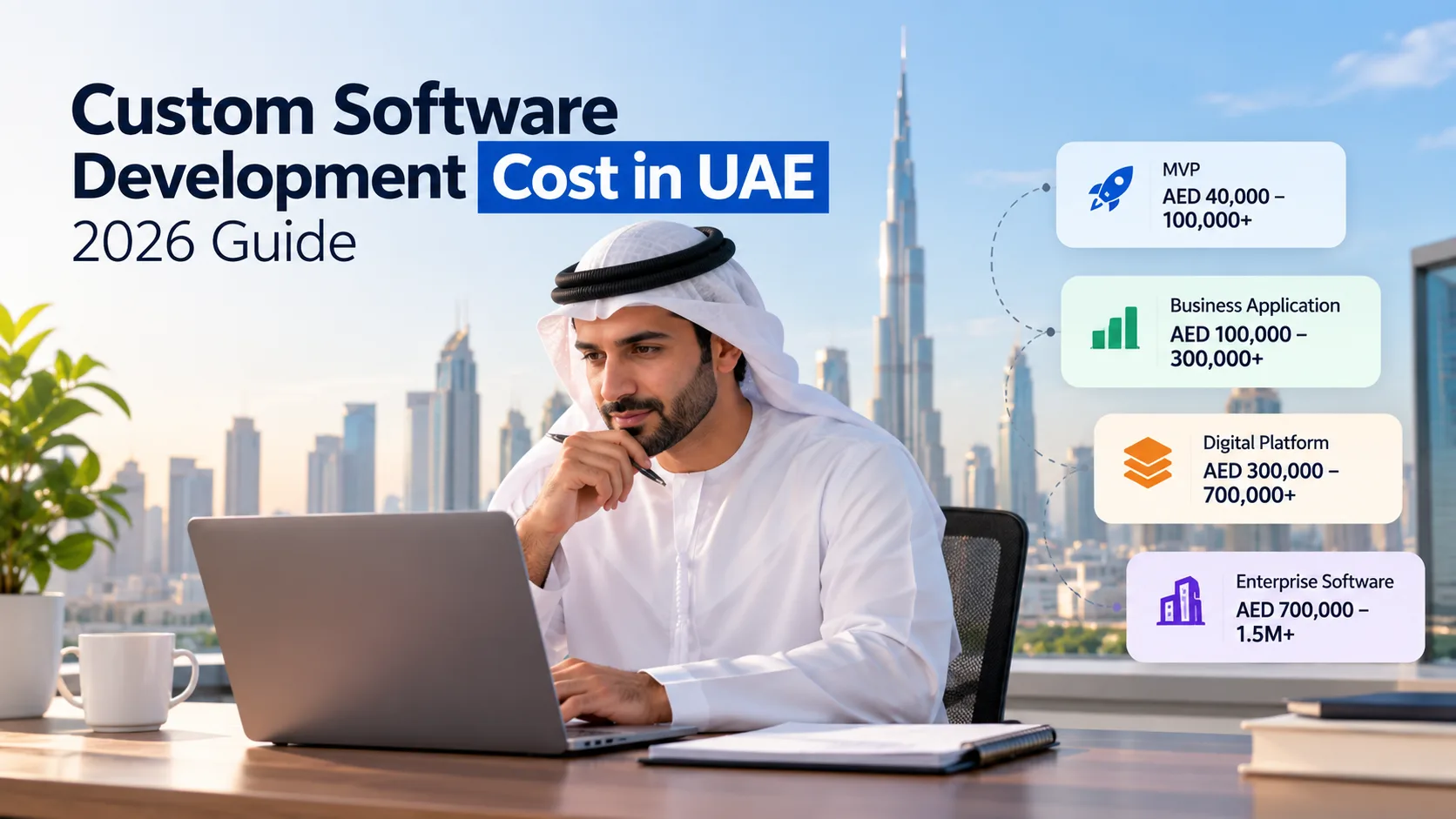
Most businesses looking for custom software development in the UAE receive a number first.
What they actually need is a framework.
A quotation of AED 150,000 from one software development company and AED 450,000 from another may appear to describe the same project. But unless you understand what each proposal includes, there is no reliable way to determine why the numbers are different. One proposal may have a narrower scope. Another may include more integrations, testing, security or post-launch support.
The important point is that these are planning ranges, not fixed market quotations. Your actual cost depends on what you are building, who will use it, which systems it needs to connect with, how secure it needs to be, and how much infrastructure is required to operate it.
This guide breaks down the major cost drivers, UAE-specific requirements, development phases, hidden expenses and software categories so you can understand what you are actually paying for before comparing development proposals.
The UAE Custom Software Market in 2026
Businesses across the UAE are investing in software to automate operations, modernise legacy systems, improve customer experiences and build new digital products.
The requirements are also becoming more sophisticated.
A business may need a customer-facing application, an internal enterprise platform, a SaaS product, an ecommerce system, an AI-powered workflow or a combination of several of these.
That makes software pricing increasingly difficult to compare using a simple "cost per application" figure.
What matters practically is the level of engineering behind the product.
A system with ten screens and complex integrations can require considerably more work than a system with thirty screens and straightforward workflows.
The same principle applies to AI, security, localisation and infrastructure.
They are not simply additional features. They can change the architecture of the entire product.
Custom Software Development Cost Overview: UAE 2026
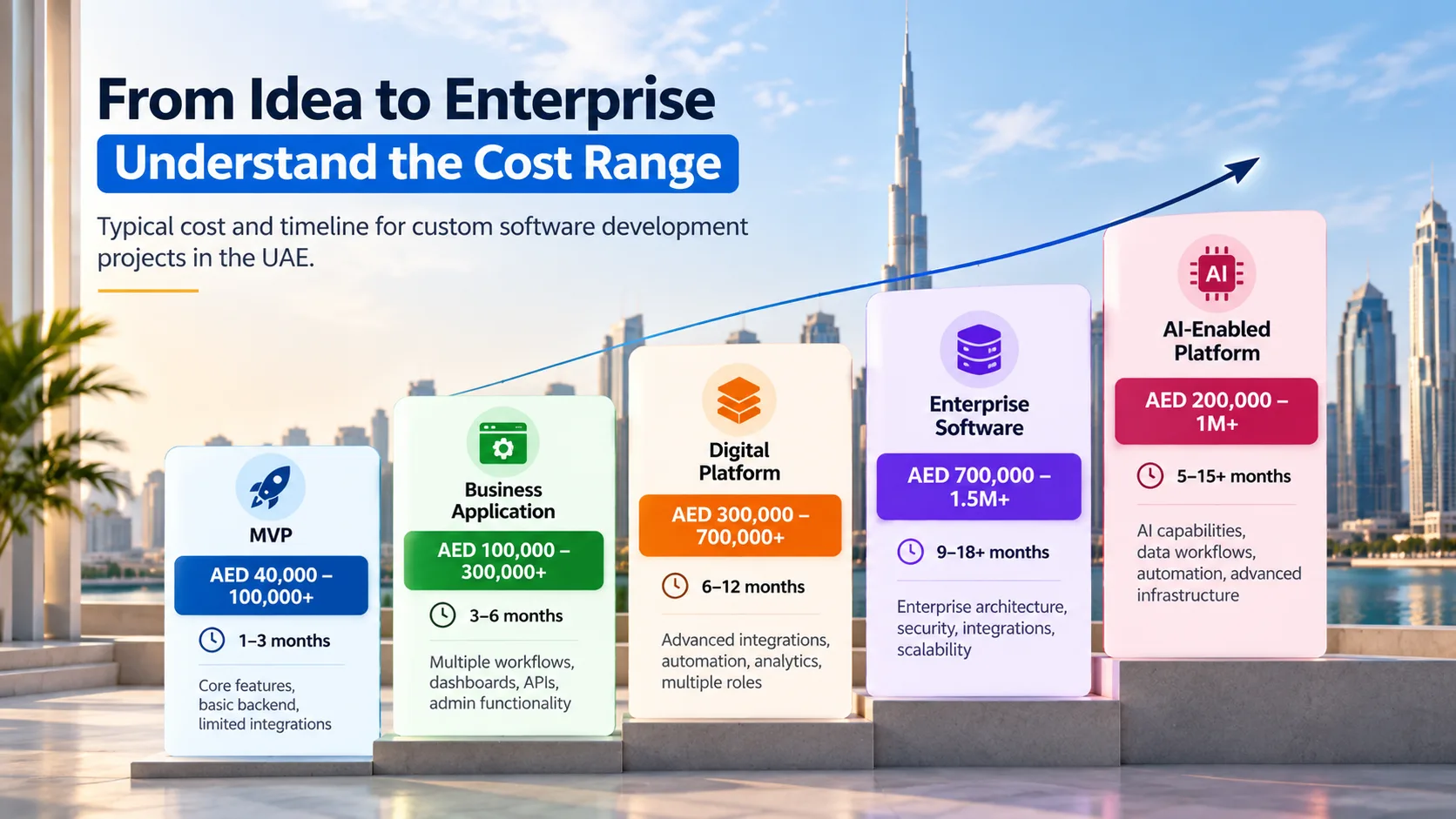
| Project Type | Estimated Cost | Typical Timeline | What It May Include |
|---|---|---|---|
| Focused MVP | AED 40,000-100,000+ | 1-3 months | Core features, basic backend, limited integrations |
| Mid-Level Business Application | AED 100,000-300,000+ | 3-6 months | Multiple workflows, dashboards, APIs, admin functionality |
| Complex Digital Platform | AED 300,000-700,000+ | 6-12 months | Advanced integrations, automation, analytics, multiple roles |
| Enterprise Software | AED 700,000-1.5M+ | 9-18+ months | Enterprise architecture, security, integrations, scalability |
| AI-Enabled Platform | AED 200,000-1M+ | 5-15+ months | AI capabilities, data workflows, automation, advanced infrastructure |
These ranges should be used to establish a budgeting framework, not to evaluate a vendor based on price alone.
A low quotation is not necessarily efficient.
A high quotation is not necessarily comprehensive.
The real question is:
What has the development company included to arrive at that number?
That is where the major cost differences usually appear.
Make Your UAE Software Budget Easier to Compare
A useful proposal should make the scope, integrations, security requirements, QA and support clear before you approve the investment.
UAE-Specific Cost Factors That Other Markets Do Not Have
Generic software development guides often focus on feature count, developer rates and technology.
For a UAE project, that is not enough.
Businesses may also need to account for Arabic RTL support, bilingual experiences, local payment integrations, data protection requirements, regional infrastructure, existing enterprise systems and industry-specific compliance.
These requirements can affect both the initial development budget and the time required to reach production.
Businesses operating in Dubai may also require a development partner familiar with the requirements of the local market, particularly when software needs to support bilingual users, regional integrations and enterprise workflows. Choosing the right software development services Dubai provider can therefore involve more than comparing development rates; businesses should also evaluate technical expertise, integration capabilities, scalability and ongoing support.
Arabic RTL Design and Localisation
Arabic support is not simply a translation exercise.
A properly localised application may require redesigned navigation, mirrored layouts, bidirectional content handling, Arabic typography, form adjustments and separate testing across both languages.
That means Arabic needs to be considered while designing the product, not after the English version has already been completed.
For example, a navigation structure that works naturally from left to right may need to be reconsidered for a right-to-left experience.
The same applies to dashboards, forms, tables, menus, icons and content-heavy interfaces.
What this means practically: If a UAE-facing product needs Arabic support, include RTL requirements in the initial UX and technical scope. Retrofitting localisation later can create additional design, frontend and QA work.
UAE Data Protection and Security Requirements
Data protection is another area where the development budget can change significantly.
Software handling personal or sensitive information may require stronger controls around authentication, access, encryption, data handling, auditability and infrastructure.
The UAE Personal Data Protection Law provides a federal framework for personal-data processing, although the specific obligations applicable to a project depend on the organisation, data and regulatory circumstances.
From a software development perspective, this can affect:
- Data architecture
- User permissions
- Authentication
- API security
- Encryption
- Audit trails
- Backup processes
- Monitoring
- Infrastructure
- Security testing
The important point is that security is not something that should be added immediately before launch.
It should influence architecture from the beginning.
Plan UAE Requirements Before Development Starts
Arabic support, data protection, payment flows and infrastructure choices are easier to estimate when they are included in discovery from day one.
UAE Payment Gateway Integration
Payment integration can also introduce additional engineering requirements.
A basic checkout may appear simple from the user's perspective.
Behind it, the application may need to manage payment authentication, transaction confirmation, failed payments, refunds, duplicate requests, webhooks, reconciliation and communication with accounting or ERP systems.
The number of payment providers also matters.
If a business needs multiple payment options, each integration can require separate development and testing.
What this means practically: Payment requirements should be included in the original technical scope rather than treated as a small feature that can be added later.
The 8 Factors That Drive Custom Software Development Cost in UAE
1. Project Complexity and Feature Scope
Feature scope remains one of the largest cost drivers.
But "number of features" does not tell the complete story.
A basic dashboard might contain user login, profiles, notifications and standard reporting.
Another dashboard might include real-time data, multiple permissions, AI recommendations, automated workflows, ERP integration and complex analytics.
Both could be called a dashboard.
The engineering effort is completely different.
| Complexity | Typical Functionality | Indicative Cost | Timeline |
|---|---|---|---|
| Basic | Login, profiles, dashboard, simple workflows | AED 40K-120K+ | 1-3 months |
| Mid-Level | APIs, payments, admin panel, reporting | AED 120K-350K+ | 3-6 months |
| Advanced | Automation, analytics, mobile, multiple integrations | AED 350K-700K+ | 6-12 months |
| Enterprise | AI, complex integrations, advanced security, scalability | AED 700K-1.5M+ | 9-18+ months |
The more business rules your software needs to understand, the more engineering effort is usually required.
That is why a detailed requirements document is one of the most valuable inputs for accurate cost estimation.
2. Technology Stack
Technology selection affects development effort, available expertise and long-term maintenance.
Meetri works across technologies and development environments including React, Next.js, Node.js, Python, Java, .NET, Flutter, cloud technologies and AI-related technologies.
But choosing a technology should not be about selecting the newest framework.
It should be about selecting the technology that fits the product.
A standard business application may benefit from mature, widely supported technologies.
A highly specialised AI platform may require a different architecture, data layer and infrastructure.
The technology decision therefore influences not only the initial development budget but also the future cost of maintaining and scaling the system.
3. Development Team Structure
The team required for a project depends on its complexity.
A smaller application may require:
- Frontend developer
- Backend developer
- UI/UX designer
- QA engineer
- Project manager
A larger platform may require additional specialists such as:
- Solution architect
- DevOps engineer
- AI engineer
- Data engineer
- Security specialist
- Business analyst
This is why comparing vendors only by their developer hourly rate can produce misleading conclusions.
You are not paying for a developer in isolation.
You are paying for the team required to design, build, test and operate the product.
4. UI/UX Design Requirements
Design is often underestimated during software budgeting.
The interface is only one part of the design process.
A serious product may require:
- User journeys
- Information architecture
- Wireframes
- Interactive prototypes
- Design systems
- Responsive layouts
- Accessibility considerations
- Arabic RTL layouts
- Usability testing
The complexity increases when the application serves different user groups.
An employee dashboard, customer portal and administrator interface may all require different workflows and permissions.
A design budget that only covers screen creation can therefore underestimate the actual UX work.
5. Third-Party Integrations
Integrations are another major cost variable.
Businesses may need to connect new software with:
- CRM systems
- ERP platforms
- Payment gateways
- Accounting systems
- Cloud services
- Communication platforms
- Analytics tools
- AI services
- Legacy applications
Each integration creates additional requirements around authentication, data mapping, error handling and testing.
Meetri's current software development offering specifically includes API integration for connecting third-party tools and legacy systems with business applications.
The practical implication is simple:
The more systems your software needs to communicate with, the more carefully integration requirements need to be scoped before development begins.
6. AI and Automation
AI can range from a relatively small integration to a major architectural component.
A business might want:
- AI chatbot
- Recommendation engine
- Predictive analytics
- Document processing
- Generative AI
- AI agents
- Workflow automation
- Intelligent search
These are not equivalent development projects.
Connecting an existing AI service to an application can be considerably different from building custom AI workflows, data pipelines or model infrastructure.
Meetri currently offers AI-powered custom software capabilities including intelligent chatbots, recommendation engines, predictive analytics and workflow automation.
The correct approach is therefore to define the business outcome expected from AI before estimating its development cost.
7. Security and Compliance
Security requirements vary according to the application and industry.
A public-facing information platform has different requirements from software handling financial, healthcare or sensitive customer data.
Potential requirements include:
- Authentication
- Role-based access
- Encryption
- Secure APIs
- Audit logging
- Vulnerability testing
- Penetration testing
- Backup and disaster recovery
- Monitoring
The earlier security is considered, the easier it is to incorporate it into the architecture.
Adding major security requirements after development has already started can require redesign and additional testing.
8. Timeline and Post-Launch Maintenance
Time can influence software cost.
If a project needs to be completed significantly faster, more development resources may need to work in parallel.
That can increase project management requirements, coordination effort and testing pressure.
But the cost does not end when the software launches.
Ongoing maintenance can include:
- Bug fixes
- Security updates
- Dependency updates
- Performance monitoring
- Cloud management
- Database maintenance
- New integrations
- Feature enhancements
Meetri's software development lifecycle includes deployment and ongoing support, including maintenance and updates after launch.
Budgeting only for development and ignoring maintenance creates an incomplete software budget.
Cost Breakdown by Development Phase
Understanding the individual phases makes it easier to evaluate a proposal.
| Development Phase | What It Covers | Typical Budget Share |
|---|---|---|
| Discovery & Planning | Requirements, goals, technical strategy | 5-10% |
| UI/UX Design | Research, journeys, wireframes, prototypes | 10-15% |
| Frontend Development | Web or mobile interface | 20-30% |
| Backend Development | APIs, database, business logic | 25-35% |
| QA & Testing | Functional, integration and regression testing | 10-15% |
| Deployment & DevOps | Infrastructure, deployment and monitoring | 5-10% |
| Maintenance | Updates, fixes and optimisation | Recurring |
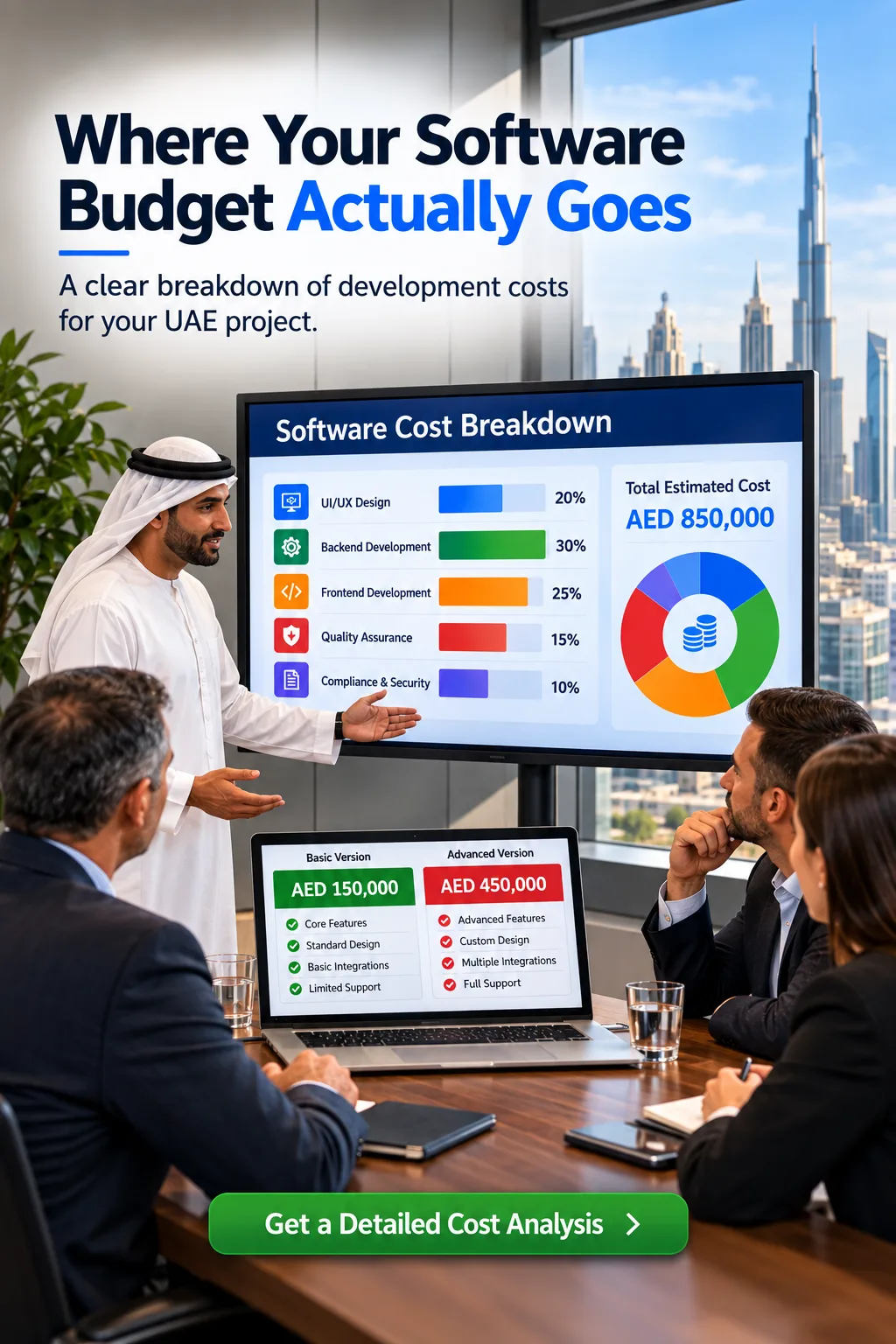
These percentages are not a universal formula.
An AI-heavy platform may require substantially more backend and data engineering.
An ecommerce product may require more effort around payments and integrations.
An enterprise platform may require greater investment in architecture, security and DevOps.
The point of the breakdown is not to predict the exact cost.
It is to make the quotation easier to understand.
Understand Where Your Software Budget Goes
Break the estimate into discovery, design, development, integrations, QA, deployment and support so you can compare proposals with confidence.
Hidden Costs UAE Businesses Consistently Miss
The development quote is not always the complete cost of owning software.
Several expenses can appear after development begins or after the product goes live.
Cloud Infrastructure
Cloud costs can depend on:
- Compute
- Storage
- Database usage
- Data transfer
- Backups
- Monitoring
- Traffic
Infrastructure requirements should therefore be considered alongside expected user growth.
Third-Party API Costs
Software may depend on paid services for:
- Payments
- Maps
- SMS
- Authentication
- Analytics
- AI
These recurring costs may be small during development but increase as usage grows.
Security Testing
Depending on the application and industry, businesses may also need periodic security testing or vulnerability assessments.
This is especially relevant where the application processes sensitive information.
Future Feature Development
The first release is rarely the final version.
Once users begin interacting with the product, businesses often identify new requirements.
They may discover:
- New workflows
- Integration requirements
- UX improvements
- Automation opportunities
- Reporting requirements
- New AI use cases
That is why a long-term software budget should include room for product evolution.
Cost by Software Type in the UAE
Different software categories have different technical requirements.
| Software Type | Indicative Cost Range | Main Cost Drivers |
|---|---|---|
| Business Web Application | AED 75K-250K+ | Workflows, users, integrations |
| Mobile Application | AED 80K-300K+ | Platforms, UX, backend |
| Ecommerce Platform | AED 100K-400K+ | Payments, catalogue, integrations |
| SaaS Product | AED 150K-600K+ | Multi-tenancy, billing, scalability |
| ERP / Business Platform | AED 250K-1M+ | Modules, workflows, integrations |
| AI-Powered Application | AED 200K-1M+ | AI architecture, data, infrastructure |
| Enterprise Platform | AED 500K-1.5M+ | Security, integrations, scalability |
These figures are useful for initial planning.
They should not replace a project-specific scope.
For example, two SaaS products can have completely different costs if one is a simple subscription application and the other requires multi-tenant architecture, complex billing, enterprise integrations and advanced security.
In-House vs UAE Agency vs Offshore Development
The development model can also influence the overall budget.
| Factor | In-House Team | UAE Agency | Offshore Development Partner |
|---|---|---|---|
| Hiring effort | High | Low | Low |
| Team scalability | Slower | Medium | High |
| Internal management | High | Lower | Shared |
| Technical flexibility | High | High | High |
| Long-term development | Strong | Project dependent | Strong |
| Best suited to | Continuous internal product development | Projects needing local presence | Long-term or flexible development |
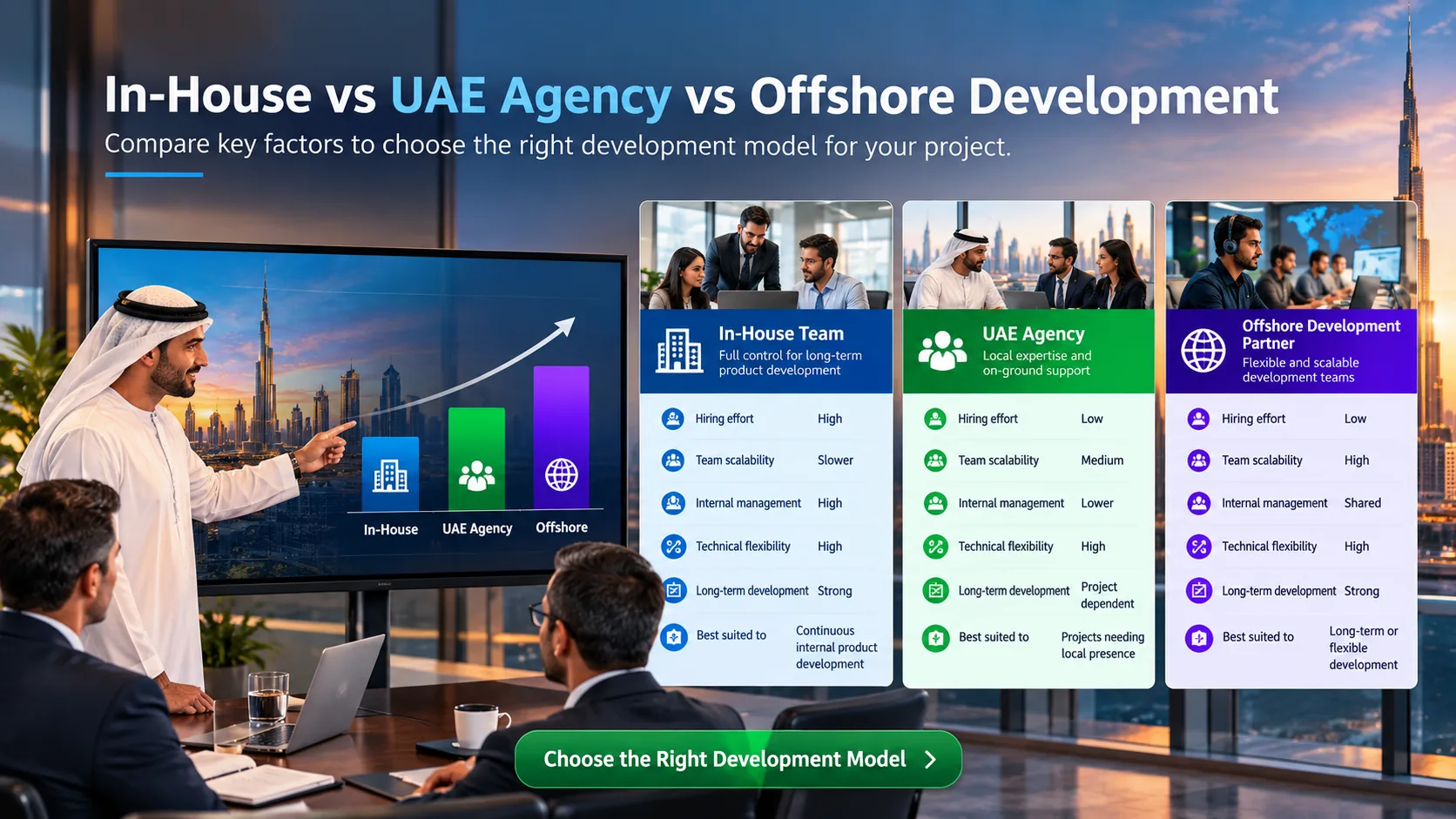
There is no universal answer.
An enterprise with a large internal engineering organisation may prefer to keep product development in-house.
A company without technical resources may prefer an agency.
A business that needs to scale a development team quickly may consider a dedicated external development model.
Meetri offers dedicated development teams alongside custom software development, with frontend, backend, API integration and QA capabilities.
The important comparison is not simply local versus offshore.
It is whether the team can provide the technical expertise, communication, delivery process and long-term support the project requires.
How to Get an Accurate Software Development Cost Estimate
A reliable estimate starts with a reliable scope.
Define the Business Problem
Do not start with:
"We need an app."
Start with:
"What business problem should the software solve?"
This gives the development team context for evaluating features and workflows.
Identify the Users
List each important user type.
For example:
- Customers
- Employees
- Managers
- Administrators
- Partners
Then document what each user needs to accomplish.
Prioritise Features
Separate features into:
Must-have -> Important -> Future
This creates a practical MVP boundary.
Document Integrations
Identify existing:
- ERP
- CRM
- Payment systems
- APIs
- Cloud services
- Legacy applications
- AI platforms
The more complete this list is, the more reliable the estimate becomes.
Define Security Requirements
Identify what type of information the software will process and what access controls are required.
Request an Itemised Proposal
Ask the development partner to separate:
- Discovery
- Design
- Frontend
- Backend
- Integrations
- QA
- Deployment
- Support
A detailed proposal makes it much easier to understand why one quotation is higher than another.
How to Reduce Custom Software Development Cost Without Reducing Quality
The objective is not to spend as little as possible.
It is to spend the budget on the work that actually creates value.
Start With an MVP
The most expensive approach is often building everything before validating the core product.
Define the most important user problem.
Build the smallest version that solves it.
Launch.
Then use real user feedback to determine what should be built next.
This reduces the risk of investing heavily in features that customers do not actually use.
Use Proven APIs
You do not need to build every capability from scratch.
Payment processing, authentication, maps, messaging and analytics often have mature APIs.
Custom development should focus on the functionality that differentiates the product.
Avoid Unnecessary Architecture Complexity
An application used by a small number of users does not necessarily require enterprise-level infrastructure from day one.
The architecture should support realistic growth without introducing complexity that provides no current business value.
Plan Arabic and Security Requirements Early
If Arabic RTL support or strict security requirements are part of the project, include them during discovery and design.
Retrofitting fundamental requirements later is usually more expensive than planning for them from the beginning.
Develop in Stages
A practical approach is:
Discovery -> Prototype -> MVP -> Validation -> Enhancement -> Scale
This gives the business opportunities to learn before committing the full budget.
How to Compare Software Development Quotes in UAE
This is where many businesses make expensive mistakes.
They compare the final number instead of comparing the scope behind the number.
Ask every development company:
- What features are included?
- Is discovery included?
- Is UI/UX included?
- Which integrations are included?
- What technology will be used?
- Who will work on the project?
- Is QA included?
- Is security testing included?
- Is deployment included?
- Who owns the source code?
- How are scope changes handled?
- What support is included after launch?
If one proposal includes discovery, design, QA, deployment and support while another does not, comparing the totals directly is misleading.
The price is only meaningful when the scope is comparable.
Why Choose Meetri Infotech for Custom Software Development?
The partner needs to understand the business problem, translate requirements into a technical solution, integrate the necessary systems, test the product and support it after deployment.
Meetri provides custom software development for startups, SMEs and enterprises, with capabilities spanning enterprise software, SaaS, web and mobile applications, API integrations, AI-powered software and product engineering.
Its development lifecycle covers discovery, planning, UI/UX design, development, API integration, quality assurance, deployment and ongoing support.
That end-to-end approach matters because software development does not stop when the first version is deployed.
The product needs to remain secure, scalable, maintainable and aligned with changing business requirements.
If you are planning a new software product, modernising an existing application or looking to integrate AI and automation into your business processes, Get in touch with Meetri Infotech to discuss your requirements and determine the most practical development approach.
Meetri also supports dedicated development teams for organisations that need ongoing engineering capacity rather than a single short-term development project.
For businesses evaluating custom software development in the UAE, the important questions are therefore:
- Can the team understand the requirement?
- Can it handle the integrations?
- Can it be built for future scale?
- Can it maintain quality and security?
- Can it continue supporting the product after launch?
Those questions provide a more useful basis for choosing a development partner than the initial quotation alone.
Ready to Scope Your UAE Software Project?
Share your requirements with MeeTri and turn the idea into a practical development plan, budget and delivery approach.
Final Takeaway: What Should You Actually Budget for Custom Software in UAE?
There is no single number that represents the cost of custom software development in the UAE.
A focused MVP and an enterprise platform may both be called "custom software", but the engineering requirements behind them can be completely different.
The budget is shaped by the combination of:
- Feature complexity
- Number and type of platforms
- UI/UX requirements
- Technology stack
- Third-party integrations
- AI and automation
- Security and compliance
- Development team structure
- Testing and QA
- Cloud infrastructure
- Post-launch maintenance
The most important lesson is that the cheapest quotation is not automatically the lowest-cost option.
A proposal that excludes discovery, QA, integrations or post-launch support may look attractive at the beginning and become more expensive once those requirements appear as change requests.
The same is true in the opposite direction.
A large enterprise architecture does not automatically make sense for a small MVP.
The right budget is the one that matches the actual business problem, product scope and expected scale.
If you are planning software for the UAE market, start by defining the users, workflows, integrations, security requirements and must-have features.
Then separate the MVP from future functionality.
Then ask development partners for itemised proposals.
That gives you something much more valuable than a headline price:
A development budget you can understand, compare and manage.
Meetri's custom software development services cover the full lifecycle from discovery and planning through design, development, API integration, QA, deployment and ongoing support, with capabilities across enterprise software, SaaS, web and mobile applications, AI-powered solutions and product engineering.
If you already have a software idea, existing application or technical requirements, the next step is to turn those requirements into a defined scope and development plan.
Start the conversation with Meetri Infotech to discuss your custom software requirements and determine the right development approach for your business.
A little more clarity
Frequently asked questions
How much does custom software development cost in UAE in 2026?
Custom software development in the UAE can range from approximately AED 40,000 for a focused MVP to AED 1.5 million or more for complex enterprise platforms. Mid-level business applications can commonly fall within the AED 100,000–300,000+ planning range. The actual cost depends on features, integrations, platforms, security, AI requirements and development team structure.
What factors affect custom software development cost the most?
The major factors include project complexity, feature scope, technology stack, development team structure, UI/UX requirements, third-party integrations, AI functionality, security requirements, project timeline and post-launch maintenance.
How long does custom software development take in the UAE?
A focused MVP may take around 1–3 months, a mid-level business application around 3–6 months, and a complex platform around 6–12 months. Enterprise systems can require longer depending on integrations, security and scope. Meetri's own service guidance similarly notes that smaller focused projects can take weeks, mid-complexity solutions with multiple integrations can take around 3–5 months, and large enterprise platforms can take six months or more.
Does Arabic support increase software development costs?
It can. Arabic support may require RTL interface design, localisation, bidirectional content handling and additional testing. Including these requirements from the beginning generally creates a more predictable development process than adding them after the English interface is complete.
Does AI increase custom software development costs?
It can. The cost depends on whether the project uses an existing AI API, intelligent automation, recommendation systems, predictive analytics, generative AI, AI agents or more complex AI infrastructure.
What should be included in a custom software development quotation?
A useful quotation should clearly define the scope, features, technology, UI/UX, integrations, testing, deployment, ownership, support and the process for handling changes to the requirements.
What are the hidden costs of custom software development?
Common additional costs can include cloud infrastructure, third-party APIs, security testing, monitoring, maintenance, infrastructure scaling and future feature development.
Is an MVP cheaper than building the complete product?
Usually, a focused MVP requires a smaller initial scope and therefore a lower initial investment. The purpose is to validate the core product before expanding functionality. The exact cost depends on what the MVP needs to accomplish.
Can custom software integrate with existing ERP and CRM systems?
Yes. Meetri provides API and software integration services designed to connect custom applications with legacy systems, CRMs, ERPs, payment gateways and other third-party platforms.
Can Meetri develop AI-powered custom software?
Yes. Meetri's current offering includes AI-powered custom software with capabilities such as intelligent chatbots, recommendation engines, predictive analytics and workflow automation.
Does Meetri provide dedicated development teams?
Yes. Meetri offers dedicated development teams for startups and enterprises requiring ongoing development, product engineering, API integration and QA support.