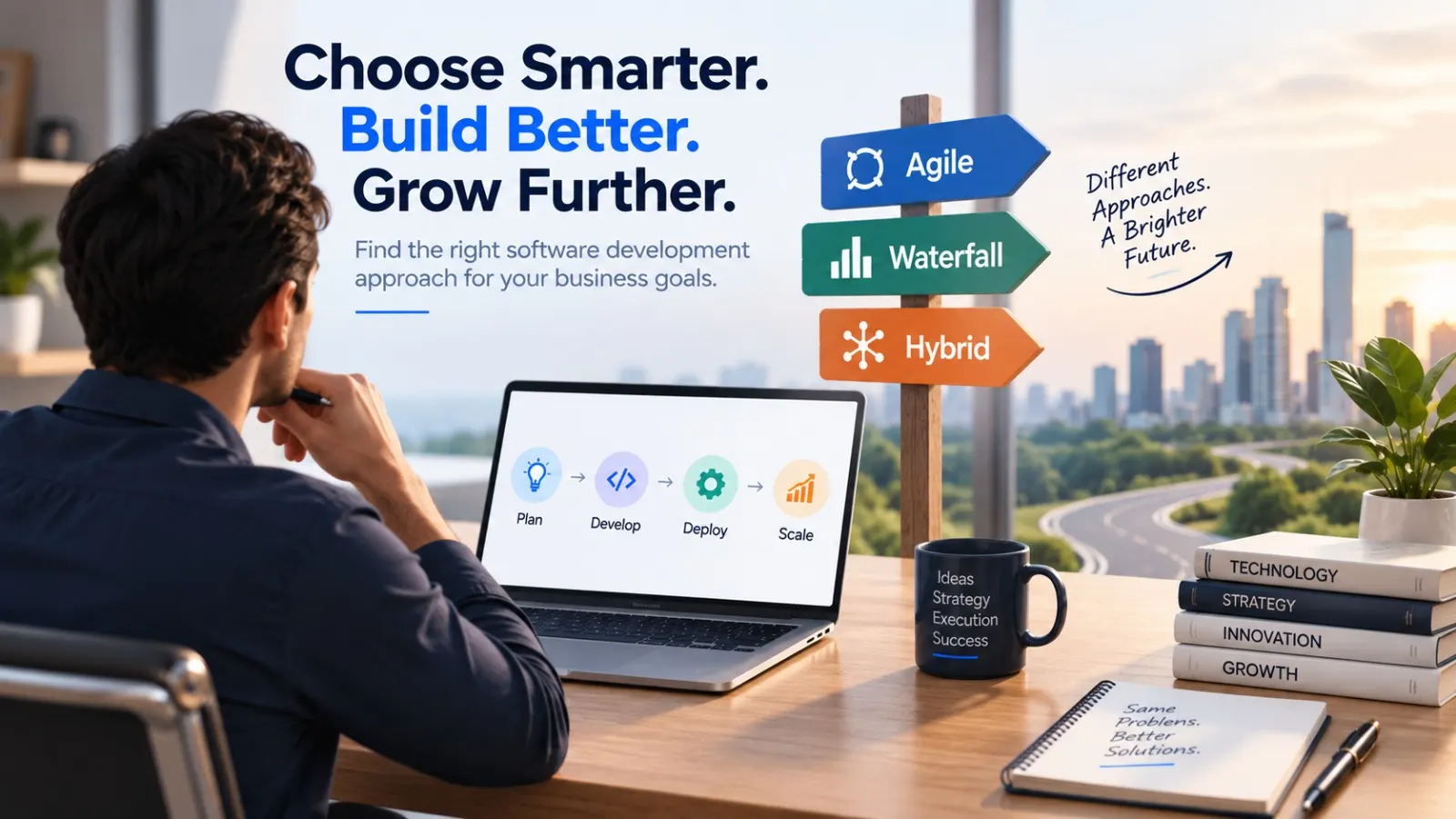
Choosing a software development approach USA businesses can rely on isn't about picking the newest methodology or automatically choosing Agile. The right approach depends on what you're building, how stable the requirements are, how quickly the product needs to evolve, the level of technical risk involved and how closely business and technical teams need to collaborate.
The important point is simple: choose the delivery approach around the project, not the project around the methodology. Waterfall can work for stable, clearly defined requirements, while Agile is better suited to products that need frequent feedback and changing priorities. Hybrid approaches can provide structure during discovery and architecture while retaining flexibility during development.
For B2B organisations, this decision also affects budget visibility, delivery risk, integration planning, scalability and the ability to respond when business requirements change.
What Is a Software Development Approach?
A software development approach defines how a software project is planned, organised, built, tested and delivered. It influences how requirements are handled, how development work is divided, when stakeholders provide feedback and how changes are introduced during the project.
A Software Development Methodology is therefore more than a project-management preference. It creates the working structure around the Development Lifecycle, from initial requirements through development, testing, deployment and ongoing improvement.
The approach you choose can affect:
- How quickly usable functionality reaches stakeholders
- How changes to requirements are handled
- How technical risks are identified
- How progress is measured
- How much planning happens before development
- How frequently stakeholders review working software
- How predictable scope, cost and timelines can be
There isn't one universal model that works for every software project. The right decision depends on the characteristics of the work.
Which Factors Should You Consider Before Choosing a Software Development Approach?
Start with the project's Technical Requirements, business objectives and expected delivery environment. Don't choose a methodology simply because your previous project used it successfully.
Consider these factors first:
Requirement Stability
If requirements are already well understood and unlikely to change, a sequential approach can provide structure. If requirements are expected to evolve through user feedback, an iterative approach may provide more flexibility.
Project Complexity
A small internal application and a multi-system enterprise platform don't have the same delivery needs. Complex projects usually require stronger architecture planning, dependency management and technical governance.
Delivery Timeline
If you need incremental releases, an iterative approach can help you deliver functionality progressively. If the project has formal stage gates, approvals or a fixed specification, a more structured model may be appropriate.
Stakeholder Availability
Agile delivery works best when business stakeholders can provide regular feedback and make prioritisation decisions. If stakeholder involvement is limited, the delivery model needs to account for that constraint.
Risk and Compliance
Projects with strict regulatory, contractual or security requirements may require formal documentation, approvals and testing checkpoints. These requirements should influence the delivery model from the beginning.
Team Structure
Your development model should also reflect how product, engineering, QA, operations and business stakeholders will collaborate. Distributed teams can work effectively, but communication responsibilities need to be explicit.
Software Development Models: Which Approach Fits Your Project?
The main Software Development Models differ in how they handle planning, change and delivery.
Agile Software Development
Agile Software Development uses iterative delivery, regular feedback and continuous prioritisation. Instead of attempting to define every detail before development begins, teams break work into manageable increments and refine requirements as they learn.
Agile can be useful when:
- Requirements are likely to evolve
- Stakeholders can provide regular feedback
- User feedback influences product decisions
- Features can be delivered incrementally
- The product roadmap is expected to change
Agile isn't simply about working in sprints. It requires active collaboration, clear priorities and a willingness to make decisions throughout the development lifecycle.
Waterfall
Waterfall follows a sequential structure, typically moving through requirements, design, development, testing and deployment in defined stages.
It can be appropriate when:
- Requirements are genuinely stable
- Scope is clearly documented
- Formal approvals are required
- The project has fixed delivery stages
- Changes later in development would be costly
Its structured nature can provide greater upfront clarity, but changing requirements can be harder to accommodate once later stages are underway.
Hybrid Development
A hybrid model combines structured planning with iterative development. For example, a team might establish requirements, architecture and major milestones upfront, then use Agile iterations to develop and refine individual features.
This can be useful for complex B2B software where stakeholders need architectural and budget visibility but the product itself will evolve during development. Current software development guidance increasingly describes hybrid delivery as a practical option for projects that need both structure and flexibility.
Define the Right Development Model
Not sure which delivery structure fits your project? Start with the requirements, risks and expected outcomes before choosing the methodology.
Custom Software Development vs Existing Software: Which Should You Choose?
The development approach shouldn't be separated from the decision about what you're actually building.
If an existing platform already meets most of your requirements, extending or integrating it may be more practical than creating a completely new system. However, if your business processes, integrations or operational requirements are highly specific, Custom Software Development may provide greater control over functionality and architecture.
Ask:
- Does an existing product cover the critical requirements?
- How much customisation would be required?
- Will the solution need complex integrations?
- Do you need ownership of the underlying application?
- Are your workflows significantly different from standard industry processes?
- How likely are your requirements to evolve?
- Will the solution need to scale with the business?
The answer should come from the business case, not from a preference for building or buying.
For organisations that need a partner to design and deliver tailored software, a Software Development Company can help translate business requirements into an appropriate architecture, delivery model and development roadmap.
How Does Project Complexity Affect the Development Approach?
Complexity changes more than the development timeline. It can affect architecture, testing, integration, governance, communication and risk management.
A relatively straightforward application may have a small number of users, limited integrations and clearly defined functionality. A larger B2B platform may involve multiple user roles, third-party systems, APIs, complex data flows, security requirements and several internal stakeholders.
As complexity increases, you need stronger control over:
- Software Architecture
- Technical dependencies
- Integration points
- Data flows
- Security requirements
- Testing coverage
- Release management
- Documentation
- Stakeholder decisions
This doesn't automatically mean using Waterfall or Agile. Instead, complexity should influence how much architecture and planning needs to happen before iterative development begins.
A useful approach is to separate discovery and architectural decisions from implementation decisions. This allows the technical foundation to be understood before development accelerates.
What Role Does Agile Development Play in Modern Software Projects?
Agile is useful when a business expects to learn during development rather than assuming every requirement can be perfectly defined at the beginning.
A typical Agile workflow might involve:
- Defining business objectives
- Prioritising requirements
- Creating a product backlog
- Planning an iteration
- Building and testing functionality
- Reviewing the result
- Collecting stakeholder feedback
- Reprioritising future work
This creates a feedback loop between business requirements and working software.
However, Agile doesn't remove the need for planning. Poorly defined priorities, weak architecture or constant scope changes can create technical debt and delivery problems. Agile works best when there is clear ownership of priorities and a disciplined Software Development Process behind the iterations.
When Is a Structured or Waterfall Approach More Appropriate?
A sequential approach can still make sense when the project has stable requirements, formal approval stages or significant constraints that make frequent changes impractical.
For example, a project may require:
- Detailed requirements documentation
- Formal design approval
- Defined testing stages
- Contractual milestones
- Regulatory checkpoints
- Predictable scope
- Controlled change management
The mistake is treating Waterfall as outdated simply because Agile is widely used. Both approaches solve different delivery problems. Current guidance continues to identify Waterfall as useful for fixed-scope and heavily controlled projects, while Agile is more adaptable when requirements evolve.
The methodology should follow the project's constraints.
How Should Businesses Choose a Software Development Strategy?
Your Software Development Strategy should connect business objectives with technical execution.
Before development starts, document:
Business Objectives
What business problem should the software solve, and how will success be measured?
Functional Requirements
What must the system actually do for users and business teams?
Technical Requirements
What performance, security, integration, scalability and availability requirements must the architecture support?
Delivery Constraints
Are there fixed deadlines, budgets, compliance requirements or dependencies that affect delivery?
Future Requirements
Will the system need additional users, features, integrations or geographic expansion later?
Governance
Who approves requirements, prioritises changes and makes technical decisions?
Once these questions are answered, selecting the development approach becomes much easier because you're matching methodology to evidence rather than preference.
Build a Clear Development Roadmap
A well-defined strategy can reduce ambiguity before development begins and give technical and business stakeholders a shared understanding of what needs to be delivered.
How Does the Software Development Process Change With Each Approach?
The overall development lifecycle remains broadly similar, but the way teams move through it changes.
A typical Software Development Process includes:
Discovery -> Requirements -> Architecture -> Design -> Development -> Testing -> Deployment -> Support
With Waterfall, these stages are generally handled in a more sequential manner.
With Agile, development and testing happen repeatedly within smaller iterations, allowing feedback to influence subsequent work.
With a hybrid approach, organisations may use structured discovery and architecture first, followed by iterative development and testing.
The important point is that methodology doesn't replace the fundamental engineering activities. It changes how those activities are organised and how decisions flow between them.
What Should You Look for in a Software Development Partner?
Choosing the right development partner is about more than checking whether they can write code. Your partner should understand the business problem, explain technical decisions clearly and work within the delivery model that fits the project.
Look for evidence of:
- Relevant technical expertise
- Experience with similar project complexity
- Strong architecture capabilities
- Clear project governance
- Quality assurance processes
- Security practices
- Transparent communication
- Integration experience
- Scalable development practices
- Post-launch support
For B2B organisations, also examine how the provider handles requirements changes, technical risks, documentation and stakeholder communication.
A Software Development Company USA businesses work with should be able to explain not only what it will build, but why the proposed architecture and delivery approach fit the business requirements.
The evaluation should therefore focus on delivery capability and technical alignment rather than simply comparing development rates.
How Can Businesses Reduce Software Development Risks?
Software projects become harder to control when requirements are unclear, responsibilities are poorly defined or technical decisions are made without considering future needs.
You can reduce risk by:
- Defining measurable business outcomes
- Documenting critical requirements
- Identifying technical dependencies early
- Establishing architecture principles
- Breaking complex work into manageable stages
- Testing continuously
- Maintaining clear decision ownership
- Tracking scope changes
- Reviewing progress against agreed milestones
- Planning security from the beginning
You should also identify what could cause the project to fail before development begins. That might include uncertain requirements, unavailable stakeholders, difficult integrations, unrealistic deadlines or insufficient technical expertise.
Risk management shouldn't be a separate document that nobody uses. It should influence architecture, prioritisation, testing and delivery decisions throughout the project.
How Do You Know Which Software Development Approach Is Right?
Use the project's characteristics as your decision framework rather than looking for a universally superior methodology.
| Project characteristic | Approach to consider |
|---|---|
| Stable requirements | Waterfall or structured sequential delivery |
| Frequently changing requirements | Agile |
| Continuous user feedback | Agile |
| Formal approval stages | Waterfall or hybrid |
| Complex enterprise environment | Hybrid or structured Agile |
| High architecture complexity | Structured discovery plus iterative delivery |
| Fixed scope and milestones | Waterfall |
| Evolving product roadmap | Agile |
| Mixed business and technical constraints | Hybrid |
This isn't a rigid rulebook. A project can change as new information becomes available, and the delivery approach can evolve with it.
The key is to make the methodology decision before development begins, while leaving enough flexibility to adapt when the project's actual requirements become clearer. The factors used by project managers when selecting development models commonly include scope, technical complexity, resources, team capability, deadlines and budget.
Conclusion: Choose the Approach That Fits the Business
The right software development approach isn't determined by whether Agile, Waterfall or another methodology is currently popular. It should be determined by your requirements, project complexity, delivery constraints, stakeholder involvement, technical risk and long-term product goals.
For businesses developing software, the most useful starting point is to define the outcome first. Then assess whether requirements are stable, how much flexibility is required, what technical architecture is involved and how the project will need to evolve after launch.
Agile can support evolving requirements and frequent feedback. Waterfall can provide structure where scope and approvals are stable. A hybrid approach can combine upfront architectural planning with iterative development when a project needs both control and flexibility.
Meetri Infotech can help businesses translate those requirements into an appropriate development strategy, architecture and delivery process. The objective isn't simply to build software. It's to create a solution that can support the business today while remaining practical to maintain and extend tomorrow.
Get in Touch with us to discuss your software requirements and explore an approach aligned with your business objectives.
A little more clarity
Frequently asked questions
How do I choose the right software development approach?
Start by assessing requirement stability, project complexity, technical risk, stakeholder involvement, delivery deadlines and long-term product requirements. These factors help determine whether a sequential, Agile or hybrid approach is more suitable.
Should I build custom software or use an existing solution?
Choose based on how closely existing software meets your critical requirements. If significant customisation, specialised workflows or complex integrations are needed, custom development may be appropriate. If an existing platform meets most requirements with limited modification, extending it may be more practical.
When should a business choose Agile development?
Agile is particularly useful when requirements may change, stakeholders need frequent visibility and working functionality can be delivered incrementally. It allows teams to incorporate feedback throughout development rather than relying entirely on requirements defined at the beginning.
Is outsourcing suitable for US software projects?
Outsourcing can be suitable when a business needs specialised technical capabilities, additional development capacity or external expertise. The important considerations are the partner's technical capabilities, security practices, communication processes, delivery model and understanding of the project's requirements.
How does project complexity affect the development approach?
Greater complexity usually increases the need for architectural planning, dependency management, testing, security controls and structured decision-making. It doesn't automatically determine a specific methodology, but it can make a purely informal development process unsuitable.
What should I consider before choosing a development team?
Consider relevant technical expertise, architecture capabilities, experience with similar complexity, security practices, communication processes, quality assurance, project governance and post-launch support. The team should also be able to explain how its delivery approach aligns with your requirements.
How can businesses reduce software development risks?
Define business outcomes and requirements early, identify technical dependencies, establish architecture principles, maintain clear ownership, test continuously and monitor scope changes. Early discovery and structured decision-making can reduce the likelihood of expensive changes later in development.