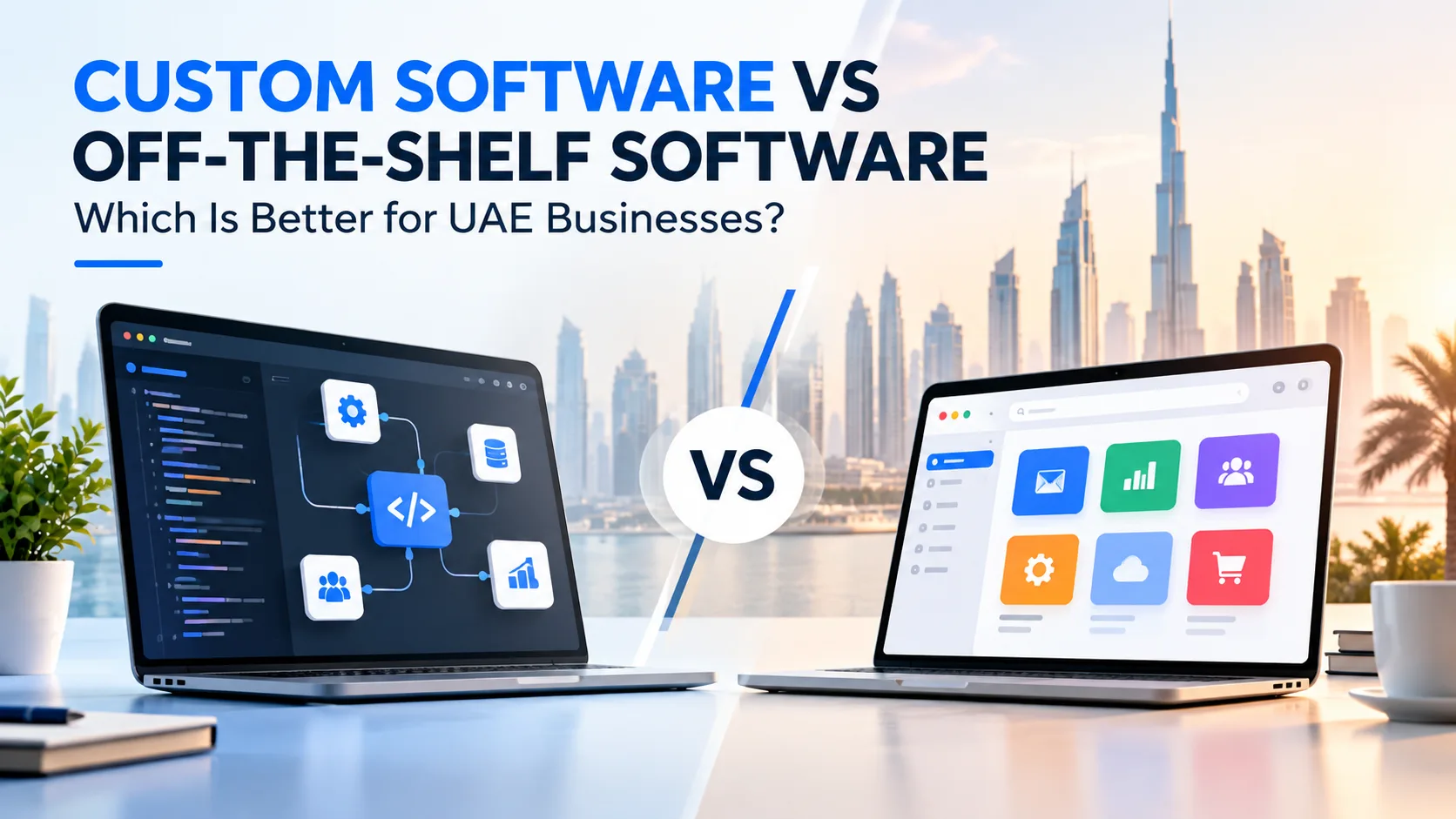
Every growing business eventually reaches a point where its software either supports growth or starts holding it back. What works for a small team may become inefficient when you manage more customers, process more transactions or expand your operations. At that stage, choosing between custom software and an off-the-shelf solution becomes an important business decision.
Off-the-shelf software offers a quicker way to access established features, while custom software is designed around your specific operational needs. However, the lowest initial price does not always represent the best long-term investment. Licensing fees, integration requirements, maintenance and future upgrades can all affect the total cost.
If you are comparing Custom Software vs Off-the-Shelf Software, the right decision depends on how well each option supports your workflows, budget, security requirements and growth plans. This guide compares both approaches, explains their costs and limitations, and helps you identify the most suitable solution for your business. If you are considering working with a Software Development Company, understanding these differences can help you define your requirements before making an investment.
Explore Your Software Options
Not sure whether to build, buy or combine both? Start by mapping the workflows, integrations and costs behind the decision.
What Is the Difference Between Custom Software and Off-the-Shelf Software?
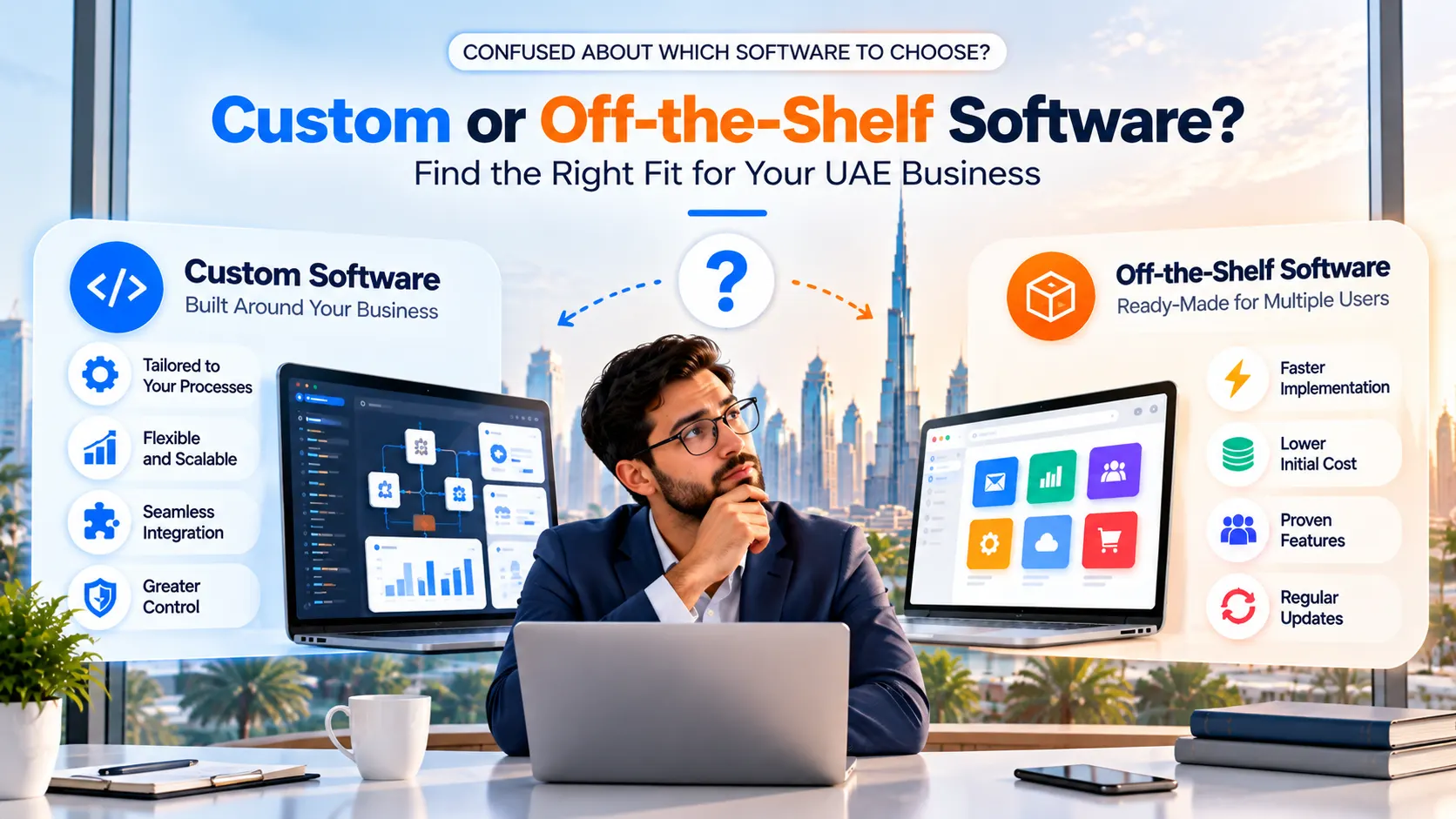
Custom software is developed for a specific organisation, while off-the-shelf software is designed for multiple customers with broadly similar requirements.
The main difference is the level of flexibility and control you have over how the software works.
Custom software development involves designing and building applications around your business processes, users, data and objectives. It can include internal business systems, customer portals, e-commerce platforms, enterprise applications and specialised operational tools.
Off-the-shelf software solutions are ready-made products that businesses can purchase or subscribe to and configure according to their requirements. They typically include standard features, documentation, support and vendor-managed updates.
For example, a company with straightforward accounting requirements may find a ready-made platform sufficient. A business managing complex approval workflows, multiple inventory systems and specialised reporting may require a tailored application or additional integrations.
Custom software is not automatically better, and ready-made software is not necessarily restrictive. The best choice depends on whether the available features solve your actual business problems without introducing unnecessary cost or complexity.
Custom Software vs Ready-Made Software: Key Differences
Understanding the differences between custom and ready-made software helps you compare the options beyond their initial prices.
| Factor | Custom software | Off-the-shelf software |
|---|---|---|
| Initial cost | Generally higher | Generally lower |
| Implementation time | Requires planning, development and testing | Often quicker to deploy |
| Business workflows | Designed around specific requirements | Follows predefined workflows |
| Flexibility | Features can evolve with business needs | Depends on vendor capabilities |
| Integration | Can be designed around required systems | Depends on APIs and available connectors |
| Licensing | Depends on ownership and contractual terms | Often subscription or licence-based |
| Scalability | Can be planned around expected growth | Depends on product capacity and pricing tiers |
| Maintenance | Requires a defined maintenance strategy | Often includes vendor-managed updates |
| Product control | Greater control, subject to contractual terms | Depends on the vendor's roadmap |
| Best suited for | Distinctive or complex requirements | Standard business functions |
Neither option is universally superior. Businesses should evaluate how each performs against their requirements rather than choosing solely on price or implementation speed.
What Are the Benefits of Off-the-Shelf Software Solutions?
Off-the-shelf software is useful when businesses need established functionality without investing in a complete development project.
Faster implementation
Ready-made products can often be deployed within days or weeks, depending on configuration, data migration and integration requirements. This makes them suitable when an organisation needs to introduce a system quickly.
Lower upfront investment
Subscription-based products generally require less initial expenditure than developing a comparable application from scratch. Businesses can access existing functionality without funding the entire development lifecycle.
However, recurring fees, premium modules, additional users and integration costs can increase expenditure over time.
Established features and support
Mature products may offer documentation, training resources, technical support and regular updates. These features can reduce the operational burden on internal teams.
Suitable for standard operations
Off-the-shelf applications often work well for common functions such as email, document management, basic accounting and project tracking.
When should you choose off-the-shelf software?
Choose it when your requirements are standard, the product meets your essential needs, and the cost of adapting the software is reasonable. There is little business value in developing a replacement for a function that an established product already handles effectively.
What Are the Benefits of Custom Software Development?
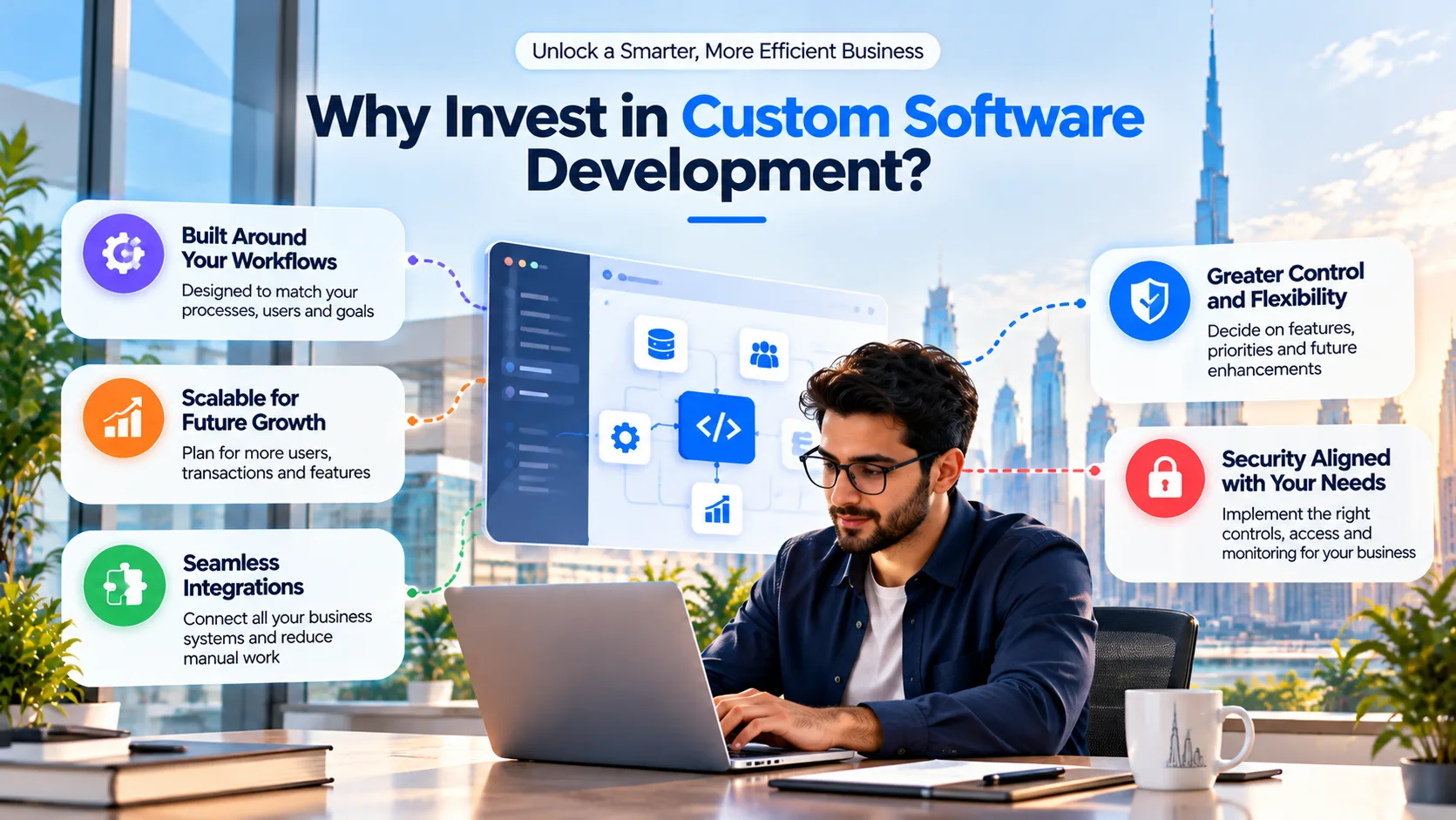
Custom software becomes worth considering when existing products cannot support important workflows or when technology plays a direct role in business differentiation.
Software designed around your workflows
Tailored applications can reflect your approval processes, reporting requirements, customer journeys and operational rules. This can reduce workarounds and help employees complete tasks more efficiently.
For example, a business with complex order management requirements could develop a system that connects order processing, inventory information and management reporting in one workflow.
Better control over scalability
Software scalability refers to a system's ability to handle increasing users, transactions and workloads without unacceptable performance problems.
Custom software allows developers to plan architecture around expected demand and future functionality. However, scalability still depends on sound engineering, suitable infrastructure, performance testing and ongoing optimisation.
Flexible system integration
Custom applications can connect different business systems through APIs and other integration methods. This helps reduce duplicate data entry, improve information consistency and make reporting more reliable.
Integration is particularly valuable when disconnected applications create delays or require employees to transfer information manually.
Greater control over product development
Custom software provides greater influence over feature priorities, product direction and future enhancements, depending on ownership arrangements and third-party dependencies.
This can benefit businesses whose internal processes, customer experience or specialised capabilities distinguish them from competitors.
Security aligned with business requirements
Custom applications can incorporate appropriate authentication, access controls, encryption, audit logging and monitoring.
However, custom software is not inherently more secure than commercial software. Its security depends on development quality, testing, infrastructure, maintenance and the effectiveness of its security controls.
Discuss Your Custom Software Requirements
If ready-made products are creating workarounds, a custom or hybrid approach may help you design around the way your business actually works.
Custom Software Development Cost UAE: What Should Businesses Expect?
The cost of custom software development depends on project complexity, feature requirements, integration needs, infrastructure and ongoing support. Businesses evaluating the Software Development Cost in UAE should compare the full investment rather than relying on the initial development quotation alone.
A simple internal application and a complex enterprise platform require different levels of planning and engineering. Consequently, a single price cannot accurately represent every software project.
Consider these cost components:
- Discovery and planning: Requirements analysis, business process mapping and technical feasibility.
- Design and development: Interface design, application architecture and frontend and backend engineering.
- System integration: Connecting existing platforms, databases and third-party services.
- Testing and security: Functional testing, performance checks and security assessments.
- Deployment: Infrastructure setup, data migration and staff training.
- Ongoing maintenance: Bug fixes, security updates, monitoring and future enhancements.
Ready-made products also involve costs, including subscriptions, licences, premium features, implementation, integrations and vendor support.
How to calculate total cost of ownership
Total cost of ownership (TCO) measures the full cost of acquiring, implementing, operating and maintaining a solution over a defined period.
For custom software, include discovery, development, infrastructure, integration, maintenance and future enhancements.
For off-the-shelf software, include subscriptions, implementation, additional licences, integrations, training, support and potential migration or exit costs.
Compare both options over the same period, such as three or five years. Use actual vendor quotations, expected user numbers and realistic maintenance estimates.
Custom software may offer stronger long-term value when it removes substantial manual work or avoids expensive recurring licences. For straightforward requirements, an existing product may remain the more economical choice.
Which Option Is Better for UAE Businesses?
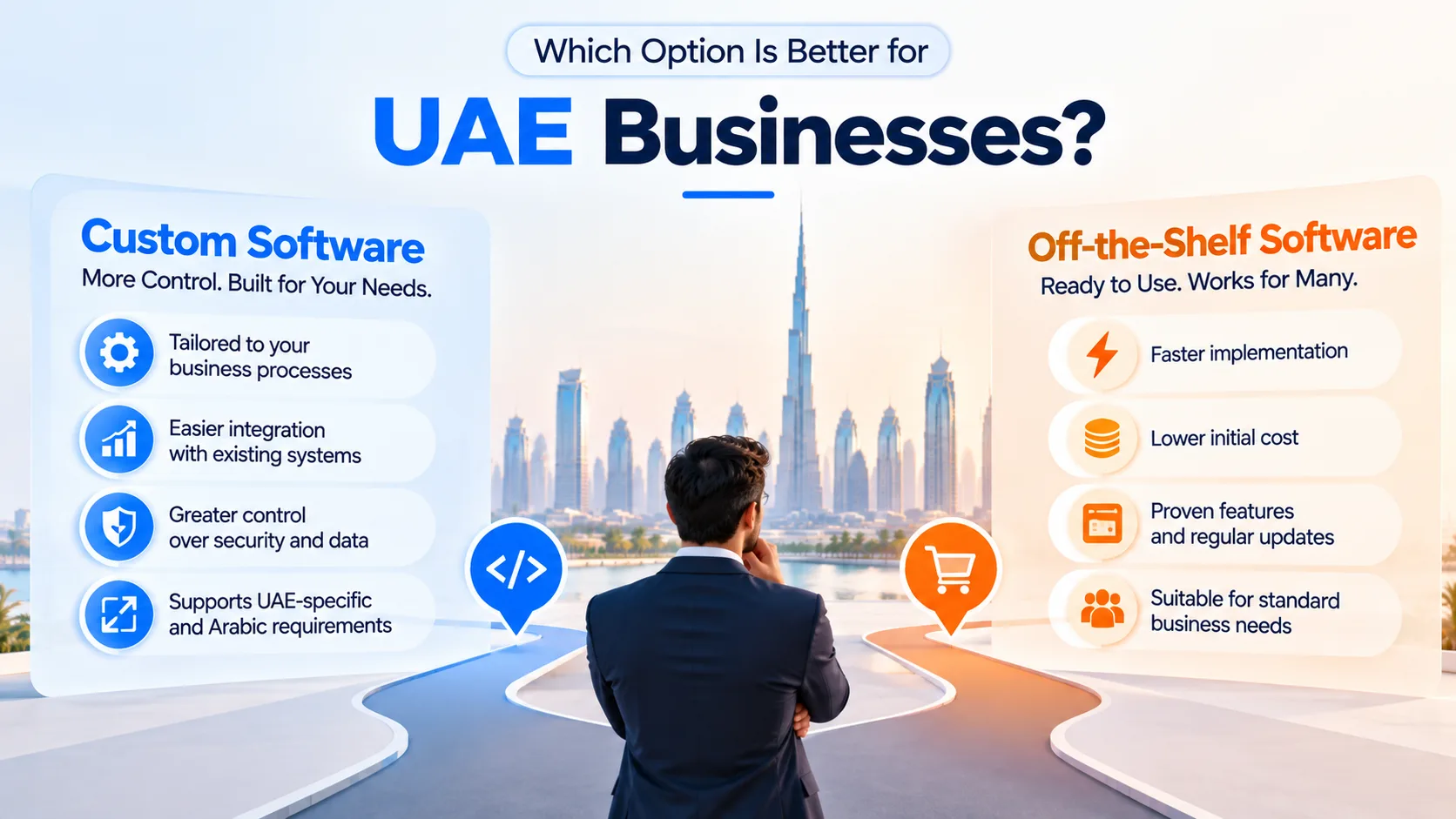
Businesses operating in the UAE should consider operational requirements alongside relevant data protection, security and industry-specific obligations.
Data protection and security
The UAE Government's data protection information provides a starting point for understanding applicable personal data protection requirements.
Businesses should assess what information their software processes, where it is stored, who can access it and how it is transferred.
Custom development can provide greater control over technical architecture and security measures. However, it does not automatically guarantee legal compliance. Ready-made products may also be suitable when their controls, configuration and contractual terms meet the organisation's obligations.
Arabic language and regional requirements
Businesses serving Arabic-speaking customers may need right-to-left interfaces, bilingual content, localised reporting and region-specific workflows.
Before selecting a commercial product, confirm whether it supports these requirements. If important capabilities are missing, customisation, integration or bespoke development may be necessary.
Tax and invoicing requirements
Finance and invoicing systems should be evaluated against the requirements applicable to the business and the relevant implementation dates.
Do not assume that every international product is unsuitable for UAE operations or that custom development automatically ensures compliance. Validate requirements against official guidance and obtain qualified advice where necessary.
Cloud computing and data location
Cloud computing supports flexible infrastructure, remote access and scalable capacity. However, businesses must still assess hosting arrangements, data location, disaster recovery and contractual responsibilities.
Both custom and commercial systems can offer appropriate deployment options. The right choice depends on the organisation's technical requirements, risk profile and applicable obligations.
When Should You Choose Custom Software Instead of Ready-Made Solutions?
Custom development is worth evaluating when existing software no longer supports your business effectively.
Consider a tailored solution when:
- Your team relies heavily on spreadsheets or manual data transfers.
- Different systems contain inconsistent information.
- Essential workflows cannot be configured in existing products.
- Licence and add-on costs are increasing significantly as usage grows.
- You need specialised reporting or business process automation.
- You are developing a digital product with unique functionality.
- Integration or security requirements exceed the capabilities of available products.
Before investing, examine whether the underlying business process can be simplified. Automating an inefficient workflow will not necessarily make it more effective.
A sound business case should identify the problem, expected benefits, current operating costs and measurable success criteria.
Validate the Business Case Before You Build
Custom software works best when the problem, workflows, expected savings and success metrics are clear before development starts.
Is a Hybrid Software Approach Better for Growing Businesses?
A hybrid approach combines ready-made applications with custom-built features and integrations. For many businesses, it offers a practical balance between speed, flexibility and cost.
For example, a business might retain an established accounting platform while developing a custom operations dashboard that combines order, inventory and performance data.
This approach can help organisations:
- Retain proven functionality.
- Avoid unnecessary development expenditure.
- Connect disconnected systems through APIs.
- Introduce automation in manageable stages.
- Replace outdated components without disrupting every operation.
The main challenge is integration management. Businesses must define data ownership, system dependencies, access permissions, API reliability and maintenance responsibilities.
A hybrid solution is not automatically the cheapest option. Its value depends on how well the components work together and whether integration costs remain manageable.
How to Choose the Right Software Development Partner
Selecting a development partner is an important part of a custom software investment. The decision should be based on technical capability, business understanding and delivery quality rather than price alone.
When evaluating a development provider, review these factors:
- Relevant experience: Can the team demonstrate experience with comparable applications, workflows and integrations?
- Requirements analysis: Does the proposed process include discovery, prioritisation and technical planning?
- Security and testing: Are quality assurance, access controls, documentation and security reviews included?
- Communication: Are milestones, responsibilities, risks and reporting arrangements clearly defined?
- Ownership: Who owns the source code, documentation and deliverables under the contract?
- Ongoing support: What happens after launch, including maintenance, monitoring and future enhancements?
For businesses assessing a Software Development Company in Dubai, it is equally important to understand the proposed delivery model, project governance and support arrangements.
A suitable development team should explain what it recommends, why the approach fits your business and how the results will be measured. Clear scope, realistic timelines and transparent communication are more valuable than promises of guaranteed results.
Explore Your Development Options
Compare build, buy and hybrid paths with a team that can assess workflows, integrations, delivery risk and long-term ownership.
How to Make the Final Decision
Before committing to either option, work through this practical checklist:
- Define the business problem and the outcome you want to achieve.
- Separate essential features from optional enhancements.
- Check whether existing products can meet your requirements without excessive workarounds.
- Compare total costs over the same period.
- Assess integrations, security, scalability and compliance requirements.
- Define success metrics, such as reduced processing time, fewer errors or improved reporting.
- Consider a phased rollout or proof of concept before approving a larger investment.
If an existing product meets your requirements at a reasonable cost, developing a replacement may not be justified. If important operational needs remain unresolved, custom software or a hybrid solution may deliver greater value.
Conclusion: Custom Software vs Off-the-Shelf Software
The decision between custom software and off-the-shelf software is ultimately about business fit, not which technology is universally better.
Ready-made software provides established functionality, faster implementation and a lower initial investment. Custom software provides greater control over workflows, integrations and future development, but requires more planning, investment and ongoing responsibility.
For many businesses, the most practical strategy is to use standard products for routine functions and invest in tailored development where existing tools create measurable limitations.
Before choosing a solution, assess your business objectives, compare the full costs and evaluate how well each option will support future growth. The right technology should solve a genuine operational problem and deliver measurable business value.
If you are ready to discuss your requirements with a software development partner Dubai businesses can consider for tailored digital solutions, start by defining your objectives, essential features and expected outcomes.
Ready to Choose the Right Software Path?
Share your objectives and we will help you evaluate whether a custom, ready-made or hybrid approach fits your UAE business.
A little more clarity
Frequently asked questions
What is the main difference between custom software and off-the-shelf software?
Custom software is developed around a specific organisation's requirements, while off-the-shelf software provides standard features for a broad customer base. Custom software offers greater flexibility but usually requires more initial investment and development time.
Is custom software more expensive than ready-made software?
Custom software generally costs more initially because it requires planning, design, development and testing. Long-term costs depend on maintenance, infrastructure, licences, integrations and the value generated. Comparing total cost of ownership provides a more accurate assessment than comparing initial prices alone.
How long does custom software development take?
The timeline depends on scope, complexity, integrations and testing requirements. A focused application may take weeks or a few months, while a large enterprise platform can take considerably longer. A phased delivery plan can make essential functionality available earlier.
Can custom software integrate with existing business systems?
Yes. Custom applications can connect with existing systems through APIs, middleware and other supported integration methods. Feasibility depends on the available interfaces, data quality, technical limitations and security requirements.
Is custom software more secure than off-the-shelf software?
Not necessarily. Security depends on architecture, coding practices, access controls, testing, infrastructure and maintenance. Custom development offers flexibility in implementing controls, while commercial products may benefit from established security teams and regular vendor updates.
Is a hybrid software approach suitable for growing businesses?
Yes. A hybrid approach combines ready-made applications with custom features and integrations. It can be useful when existing products meet most requirements but leave important workflow or reporting gaps. Integration costs and ongoing responsibilities should be assessed before implementation.
How should UAE businesses choose between custom and off-the-shelf software?
UAE businesses should assess operational needs, total cost of ownership, implementation timelines, integration requirements, security and applicable regulatory obligations. Choose ready-made software when it meets requirements effectively. Consider custom development when essential business needs cannot be met reliably through existing products.
What should businesses evaluate before investing in custom software development?
Businesses should define the problem, prioritise features, assess technical feasibility, estimate development and maintenance costs, establish ownership terms and agree on measurable success criteria. A structured discovery phase helps reduce uncertainty before development begins.